 منظمة البديل الشيوعي في العراق تنظيم شيوعي عمالي منهجه الفكري والسياسي ماركسي مستنبط من “البيان الشيوعي”
Statement by the Organisation of the Communist Alternative in Iraq regarding the life and struggle of the Communist leader Yanar Mohammed, a symbol of the emancipatory women’s struggle.

A shining star has vanished from our skies, a monumental figure has disappeared from our ranks. The world has lost a towering revolutionary communist fighter- who stood defiant against the citadels of reaction and women’s enslavement.
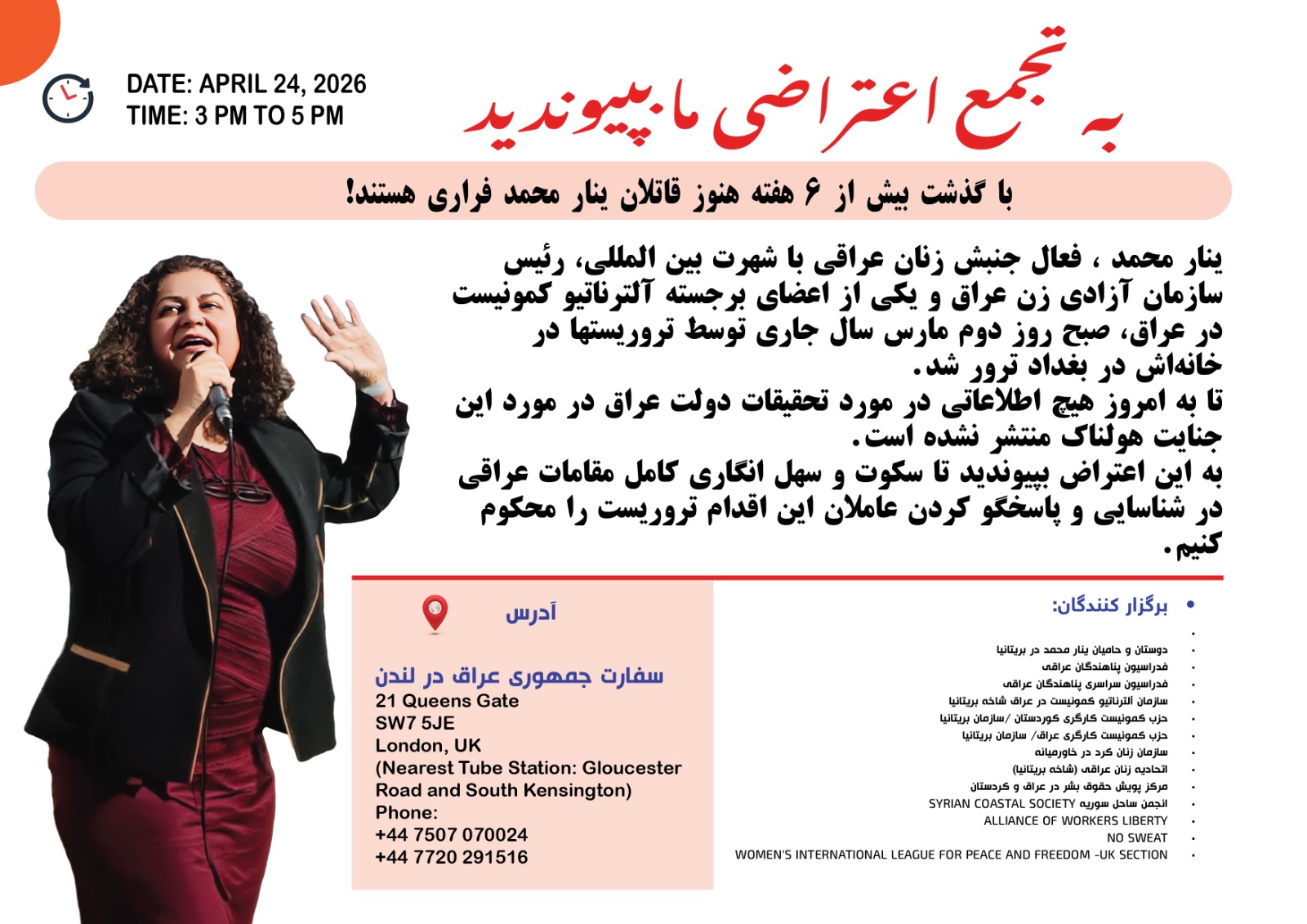
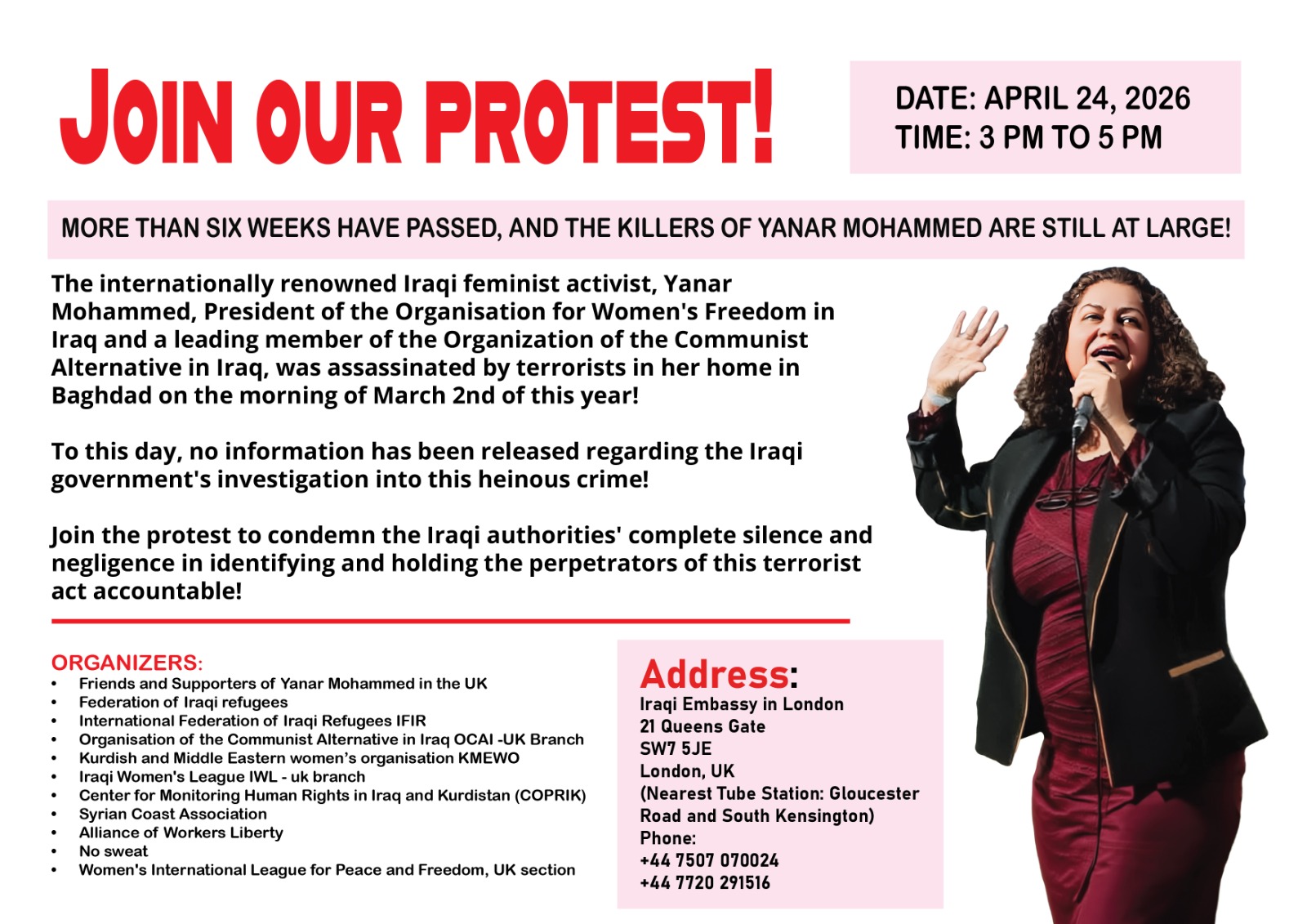
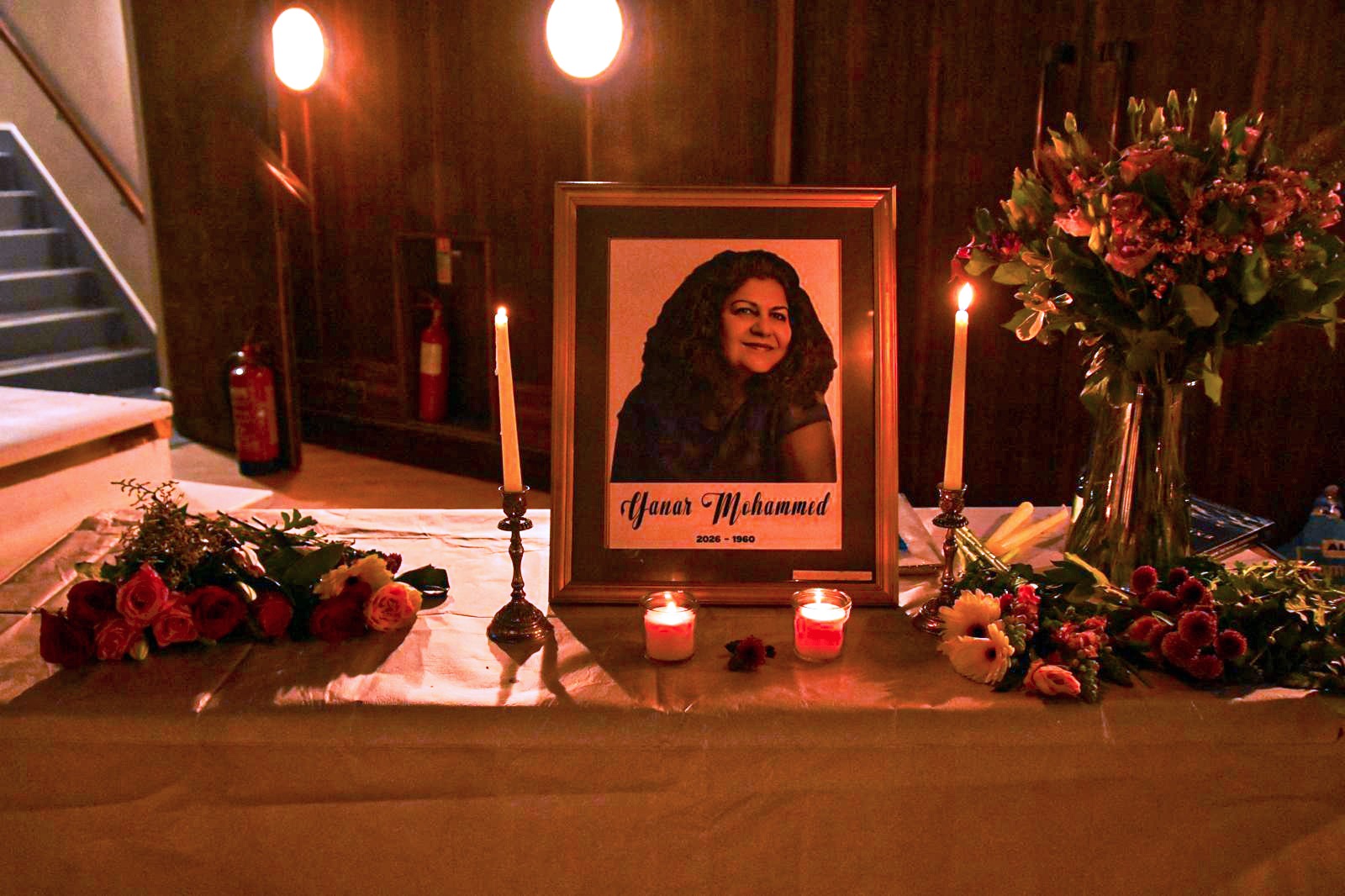
She is comrade Yanar, dear to the hearts of millions of women, communists, and freedom lovers across the world; Yanar Hassan Mohammed, President and co-founder of the Organisation of Women’s Freedom in Iraq (OWFI), and a co-founder of the Organisation of the Communist Alternative in Iraq (OCAI) and a distinguished member of its central committee. The violent hands of thuggery and crime reached her in the most brutal way; she was assassinated in her home in Baghdad, the capital of Iraq, by criminal terrorist at 9:00 AM on Monday, March 2, 2026.
As we write these lines, our hearts are bleeding, with the deepest grief and sorrow . Yet our resolve and steadfast determination, to continue Yanar’s path of struggle grows stronger every moment. We offer our deepest condolences to her husband, her beloved son, her esteemed father, her sisters, brothers, and all members of her family and friends. We also extend our condolences to her colleagues in the Organisation of Women’s Freedom in Iraq OWFI, all her comrades in OCAI, and all emancipatory women’s activists, communists, and lovers of humanity in Iraq, the region, and the world.
Yanar’s last few lines in defence of women – according to the leadership of OWFI – were the draft of a statement she finished writing at 9:00 pm Iraq time on Sunday, March 1, 2026, just twelve hours before her assassination. Below is the title, the first passage, and the final words of that draft:
“Final Statement of the 20th Conference of the Network to Combat Trafficking in Women in Iraq:
Demanding the prosecution of ISIS members for crimes of captivity, rape, and the sexual enslavement of women.
Between the transfer of thousands of ISIS prisoners from SDF prisons to Iraq across the western borders, and the beating of war drums and reckless American threats of bombing and toppling the Islamic Republic of Iran regime across the eastern borders, we in the Network to Combat Trafficking in Women in Iraq resolved to meet and address an immediate crisis affecting a wide segment of women whose dignity and bodies were violated by ISIS members. These individuals are being prosecuted in Iraq for ‘terrorism’ and membership in ISIS, without any mention of their systematic crimes against women—crimes akin to war crimes or genocide against the Yezidi, Turkmen, and Shia Shabak communities and other minorities.
………
Network to Combat Trafficking in Women in Iraq – Organising Committee of the 20th Conference, 01-03-2026.”
Yanar’s last written words as part of her communist activity within OCAI were her response to a request for her opinion on the draft of the organisation’s statement regarding the current war by the US and Israel on Iran (the statement was issued later that same night):
- 01/03/2026, 21:27 – Yanar Mohammed: “I will read it in a moment, Muayad.”
- 01/03/2026, 22:33 – Yanar Mohammed: “It is very good, Muayad. Apologies for the delay; the phone calls are non-stop.”
- 01/03/2026, 22:43 – Yanar Mohammed: “It might be missing a reference to the possibility of it expanding into a regional war.”
- 02/03/2026, 01:19 – Yanar Mohammed: “Drones have targeted Komala headquarters in Sulaymaniyah.”
Sadly, with these lines and words, she concluded her writings and her activities.
Yanar Hassan Mohammed opened her eyes to the world in Baghdad on 15th Nov.1960, where she completed her primary and secondary education. She graduated from the University of Baghdad in 1984 with a Bachelor’s degree in architecture, later earning a Master’s degree in the same field from the same university in 1993. She practised her profession as an architect in Iraq, Lebanon, and Canada from her graduation until 2003, through the harsh conditions of the Iran-Iraq war, the years of economic sanctions, and later her years of migration to Beirut and then Toronto.
As a young woman who excelled in her field, she possessed an extraordinary brilliance in evaluating social, political, and cultural life. Her ability to diagnose the signs of patriarchy in its subtlest manifestations, combined with her practical understanding of women’s suffering under male dominance, led her – even before being influenced by socialist political thought – to adopt a theory of rebellion against patriarchy. This rebellion became her benchmark for evaluating political trends, intellectual movements, parties, activists, and even her friends and comrades; this remained her compass throughout her life.
However, as she engaged in political work and empowered herself theoretically by reading Marxist literature and the ideas of emancipatory women’s movements, she became a partisan communist political fighter. She linked the defeat of patriarchy, and the economic, social, political, and cultural system that stands behind it and reproduces it, to organised political and intellectual struggle. Not only that, but she quickly realised that emancipatory women’s radicalism and communism must be socially deeply rooted in society and connected to the depths of the downtrodden classes and oppressed women on a broad social scale.
Yanar was an individual who cherished life in every sense. Anyone who met her was instantly impressed by her humanity, her sense of humour, her intelligence, and her wit. These qualities were evident not only in daily conversations but also in her handling of complex, thorny issues and political debates. Yanar never adopted an emancipatory feminism that was isolated from the enjoyment of life or the strive for achieving the hidden creative potentials and talents in individuals. She believed in free, equal human relations between the sexes. Unlike some women activists, she stood firmly against those who hated men as biological beings or stripped patriarchy of its class and social content as a transient socio-economic, political, and cultural phenomenon in human history.
She struggled powerfully against all forms of national, sectarian, and religious discrimination, as well as discrimination based on colour, race, gender, and more. For her, the empowerment and resilience of every survivor of violence and trafficking was a revolutionary task and a project, one that secured a decent, safe and enjoyable life, and released the woman’s power and creativity. This formed the core of her strategy in protecting survivors and victims of violence.
Yanar entered the world of politics and organised communist and emancipatory women’s activism , carrying these characteristics—a revolutionary communist personality and a steadfast emancipatory woman. This was something only a few of her comrades and friendsthoroughly understood , despite the fact that most recognised the importance of her struggle and held great appreciation and respect for her, her status, her charismatic personality, her policies, and her humanist emancipatory outlook.
Throughout all the milestones of communist struggles within the movement, Yanar never for a moment abandoned the importance of communist partisan organisation or the necessity of linking the cause of women’s emancipation to overthrowing the entire existing capitalist socio-economic system. In all the turning points and splits witnessed by the radical communist movement over the past three decades, she was an important and influential figure, deciding matters for herself with precision and care, according to her deep-seated political and intellectual convictions.
From a young age, Yanar was influenced by leftist atmospheres within her family circles, following the traditions of the Iraqi Communist Party’s general political and intellectual activity at the time. However, her organised political life began in Canada during the General Conference of the Canadian organisations of the Worker-communist Party of Iraq in the late 1990s. This was preceded by a period where she familiarised herself with the party’s activities, immersed herself in their environment, built friendships, and attended their celebrations and events.
While in Canada and before her formal party affiliation, Yanar found in the political tradition and theses of Comrade Mansour Hekmat an alignment with her own radical critique of patriarchy and her defence of women’s freedom and equality. She saw in these ideas an advanced development of concepts she had previously adopted in a less defined manner from global and local socialist circles regarding socialist critique and the struggle for political and civil liberties.
She rapidly embraced the radical critique within these theses directed at political Islamic movements, their parties, and their authorities, as well as the radical defence of women’s emancipation and secularism included in the theses. She adopted the slogan of separating religion and nationality from the state and education, alongside a critique of U.S. imperialist policies, strategies, and its enslaving wars. Furthermore, she adopted core socialist concepts, emphasising the abolition of wage labour and capitalist property relations, while maintaining a radical stance against the U.S. war on Iraq.
Yanar entered the arena of politics and organised partisan struggle in Canada, while adopting these socialist and emancipatory women’s thoughts. She struggled against the U.S. economic blockade imposed on Iraq and the “Faith Campaign” launched by the fascist Ba’athist regime against women. She entered this field as the world began, shortly thereafter, to experience political and military storms of global proportions, characterised by the transfer of the direct effects of political Islamic terrorism into the heart of the Western world and the subsequent U.S. imperialist “War on Terror.”
Amidst these global stormy events, Yanar began her activism in Canada against both forces: against U.S. imperialism, its war, and its occupation of Iraq, and against the currents of political Islam. Above all, she fought their shared hostility toward women and the cause of emancipation and equality. The former (imperialism) operated by shattering the civil fabric of societies, imposing economic blockades, and supporting reactionary religious, nationalist, sectarian, and tribal forces—mimicking the American model in Afghanistan. The latter (political Islam) operated through direct repression, terrorism, and the blatant enslavement of women.
Thus, Yanar entered the world of politics through protests and demonstrations, utilising her personal oratory skills and her remarkable eloquence in the media , in both Arabic and English. She worked to expose the reactionary essence of the U.S. war on Iraq and the terrorism of political Islam, quickly gaining recognition in Canada and the United States. Sometime before the 2003 war, she co-founded the “Defence of Iraqi Women’s Rights Committee” with activists in Canada. As part of the committee’s activities, following an assault by Ahmed Chalabi’s security team on an activist in Toronto, she released a statement on October 14, 2002. In it, she reaffirmed her opposition to U.S. war policy, concluding with the words: “Down with the American puppet and the criminal U.S. policies toward Iraq… The women of Iraq deserve a much better future than this… a future of peace, liberties, and full equality between women and men.” This conclusion was preceded by her condemnation of the “criminal Ba’athist regime” for the killing of 250 Iraqi women during the “Faith Campaign” launched by the regime in 1996.
However, the emergence of Yanar Mohammed within Iraqi society and on the global stage truly began after she co-founded with some other women’s activists the Organisation of Women’s Freedom in Iraq (OWFI) in Baghdad in June 2003, which occurred just two months after the fall of the fascist Ba’athist regime, amidst the atmosphere of the criminal war and the US imperialist occupation of Iraq, the uncertain horizons and the danger of bloody political storms that threatened to engulf Iraqi society from all directions and on all levels – storms that later manifested as massacres, sectarian warfare, identity-based killings, the destruction of society’s civil infrastructure, terrorist bombings, and the rise of militias. These forces empowered various reactionary, anti-woman elements, from tribal powers to religious institutions, ultimately casting women into the most oppressive and catastrophic era in modern Iraqi history.
Only six months had passed since the organisation’s founding when, on the evening of December 31, Yanar Mohammed received an email from an Islamist group called “Army of the Sahaba.” The subject line read: “The killing of Yanar Mohammed within a few days.” From that moment until the very instant of her assassination, she received various forms of death threats which never ceased throughout her twenty-three years of desperate struggle amidst the tragedies, massacres, and destruction Iraq endured. These threats, often compounded by various forms of pressure, harassment, and malicious lawsuits,persisted even during the October 2019 uprising, when political Islam retreated in the face of the mass movement in Iraq.
Furthermore, the media campaigns inciting the murder of Yanar and OWFI activists—along with the provocations to shut the organisation’s offices and its media outlets, such as “Al-Musawat Radio” (Equality Radio) and “Al-Musawat Newspaper”—remained constant throughout the history of Yanar Mohammed’s political work and continued to this day. These incitements were dressed in the most scandalous lies and malicious political fabrications woven by militia forces, political Islamic currents, and their various criminal intelligence apparatuses.
It’s important to mention that several people within the movement, who called themselves falsely & deceptively “leftists”, in fact joined the ranks of these criminal forces and their incitements aimed at assassinating Comrade Yanar. .” In truth , these so called “leftists” originally belong to the breed of chauvinistic, male- dominant politicians with petrified Islamic-nationalist and sectarian cultural tendencies, as well as circles of national chauvinists. These groups also launched several & continuous malicious social media smear campaigns against Comrade Yanar, OWFI, and the Organisation of the Communist Alternative, even going as far as publishing photos and specific personal details all of which contributed to creating the atmosphere that led to her assassination.
The history of the struggle of our dear Yanar and the Organisation of Women’s Freedom in defence of women’s rights and freedoms is rich with sacrifice and achievement: from the difficult task of founding and managing the organisation, to the publication of “Al-Musawat Newspaper” in April 2004 and the launch of “Al-Musawat Radio” in the organisation’s early years. Added to this is the establishment of branches in various provinces, the founding and management of shelters for victims of violence and survivors of women-trafficking, and her active participation in organising protests, marches, and rallies. She participated in demonstrations, marches, and rallies, and played an active role in organising women, labour, and socialist festivals annually on May Day and IWD.
Yanar continued to fight with unwavering resolve in the field of legal and rights-based activism. Her efforts ranged from organising various campaigns to abolish anti-woman laws within the Iraqi judicial system to confronting the attempts of ruling Shiite political Islamic parties to enact new sectarian laws, which sought to strip Iraqi women of the rights and freedoms they had historically acquired.
The milestones of struggle for Yanar and OWFI in this field are numerous. They began with a confrontation over Resolution 137 of the “Transitional Governing Council” in late 2003, which sought to impose the “Jaafari Personal Status Law.” In this context, Yanar Mohammed organised a seminar against Resolution 137 titled “No to the Enslavement of Women in Iraq on January 29, 2004. She also participated in a women’s demonstration where she delivered a speech on the necessity of ending the era of women’s oppression by resorting to the struggle of the women’s movement demanding equality. The speech was broadcast on all local television channels and several international networks that same evening”. Shortly thereafter, she received her first death threats.
Yanar continued to fight against subsequent campaigns to enact the Jaafari Law in 2014 and 2024. In July 2024, she and OWFI, along with a group of activists and lawyers, initiated the founding of the “188 Alliance” to oppose the “Amendment to Personal Status Law No. 188 of 1959.” She also struggled fiercely against the passage of the “Jaafari Code of Provisions” in Parliament in August 2025—a move resulting from a shameful bargain between the blocs of Arab and Kurdish nationalist parties and the Shiite political Islamic parties. This reactionary code aimed to pass anti-woman legislation that opens the door to the crime of child marriage.
Furthermore, Yanar struggled continuously in the political arena to achieve political freedom, civil rights, and equal citizenship rights. She advocated for the separation of religion and nationality from the state and the educational system, and she stood against corruption, the dominance of militias, tribal powers, and the hegemony of religious authorities, hostile to women’s and children’s rights.
As part of her partisan struggle, Yanar joined the “Iraq Freedom Congress” (IFC) for a period, being one of the signatories to its founding, initiated by the Worker-communist Party of Iraq in 2004. However, she withdrew from the Congress relatively early after observing negative developments within the project that contradicted the communist and emancipatory women’s goals to which she was committed.
Perhaps the greatest challenge in dear Yanar Mohammed’s activity was her struggle to rescue women who were victims of violence, those under threat of “honour” killings, and young women caught in the grip of human trafficking networks. Despite the immense complexities, the hardships of management, the challenges of securing funding, and the constant death threats from militias, gangs, and mafias of all stripes, Yanar prevailed. Through her iron will and the exhaustive efforts of activists within OWFI and several of her communist cadre comrades, she succeeded in saving approximately 1,400 young women from the dangers of death, exploitation, and homelessness.
Yanar paid special attention to the intellectual and political advancement of activists and survivors. To this end, she spent years establishing and sustaining emancipatory women’s schools and schools for Marxist education. These schools bore significant fruit, as some women’s activists became armed with the historical materialist outlook to understand the cause of women’s oppression and emancipation, which enabled them to carry out their tasks with high efficiency.
Yanar Mohammed was a revolutionary communist, a militant. She struggled alongside the unemployed within the ranks of the “Union of the Unemployed in Iraq”, participating in its continuous protests and sit-ins before the U.S. Temporary Coalition Provisional Authority in Baghdad during the summer of 2003. Since those days, Yanar’s activities were never separated from her support for workers’ struggles in various sectors—most notably the struggles of the workers in the industrial sector, their demonstrations, and their conferences against privatisation, industry’s restructuring, and mass layoffs.
Until the final moment of her life, she struggled fiercely in defence of the “Federation of Workers’ Councils and Unions in Iraq” (FWCUI) including its former president, Falah Alwan. She provided all possible facilities to develop the work and struggle of this federation and maintained a supportive stance toward its socialist-labour strategy. She stood firmly against the splits that occurred within its ranks between 2004 and 2007 and consistently assisted the federation by all available means in organising campaigns, conferences, and joint seminars.
Yanar Mohammed constantly sought the development of the labour movement and this socialist-oriented federation, striving to make the cause of women’s emancipation a fundamental task of the labour movement, including trade unions and labour federations. This stemmed from her steadfast belief that the cause of women’s emancipation and emancipation from the class system are two inseparable and intertwined matters.
Yanar participated in all milestones of social struggle for the provision of public health and educational services, and in struggles against the privatisation and neoliberal policies of the ruling nationalist and Islamic bourgeois regime, as well as against financial and administrative corruption and the looting of society’s wealth. For 23 years, she supported the struggles of the masses to achieve the economic demands of workers, the unemployed, and wage labourers.
Yanar strongly supported the protest movements of the youth, the toilers, and the unemployed across all their stages, starting from 2011, 2015, 2017, and 2018, leading up to the October Uprising of 2019. Yanar supported these protests and participated in them with the Organisation of Women’s Freedom with full force, delivering speeches in many of them, defending the demands of the protesting masses and, specifically, the issue of women’s rights, freedom, and equality, struggling for these movements to adopt emancipatory policies toward the women’s cause.
However, her most significant participation was in the October Uprising. Two days before the uprising began, as a member of the Central Committee of OCAI —which had been founded about a year and two months prior—she contributed to issuing the organisation’s statement affirming its support and joining the anticipated revolutionary mass surge. She participated in and approved of issuing the organisation’s political platform regarding the uprising, its slogan “All Power to the Rising Masses,” and its document “General Outlines for Councils Movement,” defending them vigorously.
Yanar participated personally in the October Uprising for a period, delivering speeches at open mass speeches organised by the members and Central Committee of the Organisation of the Communist Alternative in Tahrir Square in Baghdad every evening, under a tent bearing the slogan “All Power to the Rising Masses.” She also contributed to the publication of the newsletter “Women of the Uprising”, a joint project between the Organisation of the Communist Alternative and the Organisation of Women’s Freedom, writing for it, particularly its early issues.
Despite the doors being opened for the participation of broad sectors of women in this uprising—following the temporary retreat of political Islamic currents— Yanar expressed her reservations regarding the failure of the youth and activists of the uprising to adopt an emancipatory political vision and policy toward the women’s cause. This was a precise diagnosis; the atmosphere of enthusiasm that permeated the uprising did not obscure Yanar’s criticism of the deficiency in the political projects of youth movements, which failed to give the necessary importance to the cause of women’s emancipation and equality, even for the sake of strengthening the uprising and achieving its political goals of salvation from the existing political regime.
Support for labour movements, protests, and women’s and mass activities across the globe, and particularly in the Middle East, constituted one of the most important arenas of Yanar’s activity. She fiercely defended the revolutions in Tunisia and Egypt and the revolutionary mass surge in the region that followed. She also defended the struggles of the masses of women in Iran to liberate themselves from the nightmare of the ruling Islamic regime’s forces there.
In September 2023, during a rally organised by the organisation of the Communist Alternative in Iraq and the organisation of Women’s Freedom in Firdos Square, Baghdad, Yanar delivered an influential solidarity speech for the women of Iran and the revolutionary mass protests triggered by the killing of the young woman Mahsa (Jina) Amini. Following this solidarity stand, Yanar and OWFI faced continuous harassment from the authorities and the filing of malicious lawsuits aimed at prosecuting them, closing the organisation’s offices, and blocking its activities.
Yanar’s struggles for women’s emancipation and the advancement of the communist movement—from an emancipatory women’s and revolutionary Marxist perspective—and her global presence in the media, international women’s networks, socialist currents, organisations, parties, and unions, made her a globally recognised figure defending women’s rights and human freedom. She was recognised within international bourgeois platforms and institutions, including the United Nations, where she delivered a speech, and the BBC, which selected her as one of the 100 leading women in the world in 2018.
Yanar received numerous international awards: the Gruber Prize for Women’s Rights (2008), the Thorolf Rafto Memorial Prize (2016), and the Franco-German Prize for Human Rights and the Rule of Law (2025). On the 20th anniversary of the occupation of Iraq, she participated in a program alongside internationally renowned leftist and socialist figures within the global “Anti-War” movement to express her views on the U.S. war on Iraq, highlighting the tragedies this war inflicted on the masses, especially women in Iraq and the region.
However, the most important role and fundamental revolutionary characteristic of Yanar Mohammed was her identity as a revolutionary communist fighter. She continued to struggle for a world free of classes, the state, and all forms of coercion, oppression, and discrimination through organised partisan struggle within a communist current. She never wavered in this commitment despite all the hardships she faced in her party life over nearly three decades.
Her struggle for women’s emancipation and the achievement of their rights and equality was inseparable from her critique of and struggle against the capitalist class system. Her thesis—that an organised communist current should serve as a backbone for the emancipatory women’s movement, OWFI, and her own activities—was not a tactical policy for her; rather, it was a political outlook and a communist, emancipatory women’s strategy.
She believed that a communism not empowered by the cause of women and their emancipation is nothing but a Stalinist, mechanical, bourgeois communism, or the communism of radical nationalist bourgeois currents and compromising reformists, having no relation to the working class or the masses of oppressed women. Her fear was not the dominance of feminism over the organised communist current within which she worked, but rather that the communism of her party or organisation might not be liberated from patriarchy and the dominance of religious and nationalist patriarchal culture.
Despite some difficulties that accompanied Yanar’s partisan struggle within the Worker-communist Party of Iraq after 2003, she remained committed to the party and the struggle within its ranks. She was convinced of the necessity of internal partisan struggle, accepted differences of opinion, and sought to preserve party unity.
However, on May 6, 2018, during the 33rd Plenum of the Central Committee of the Worker-communist Party of Iraq, Yanar Mohammed submitted her resignation from the Central Committee, followed by her resignation from party membership a few days later. With this, she concluded over 18 years of struggle within that party.
After leaving the Worker-communist Party of Iraq, she did not engage in sideline partisan polemics, nor did she disown her struggle within its ranks. Rather, she considered it a cherished part of her personal political and partisan history. Regarding political differences within the communist movement, Yanar did not encourage preoccupation with such disputes; she discouraged opening fronts of conflict that would divert communists and emancipatory women from major political issues and from confronting the grave dangers surrounding the women’s and communist struggle in a society dominated by various reactionary forces. It is important to note here that despite her critiques of some of Comrade Mansour Hekmat’s policies, she maintained great appreciation and respect for him, emphasising the significance of his stature, ideas, and struggle within the communist movement in Iraq and the region.
Yanar did not cease her organised communist struggle. After she resigned from the Worker-communist Party of Iraq, she took the initiative, alongside a group of other comrades, to found OCAI, issuing its founding statement on July 25, 2018.
Comrade Yanar’s struggle within OCAI was also not without obstacles, particularly in its initial stages, when it was joined by a group of comrades who had not yet abandoned the legacy of patriarchy and who subsequently left the organisation shortly thereafter. Yanar remained, until the final moment of her life, a staunch adherent of OCAI, viewing it as a powerful tool in her struggle to achieve her communist and emancipatory women’s goals. She held the organisation in high regard, considering it a significant gain for the communist movement. In this context, it is essential to mention that until her final days, she encouraged activists in the Organisation of Women’s Freedom (OWFI) to commit to and join the Organisation of the Communist Alternative, telling them that it is a vital revolutionary communist tool for their empowerment and the strengthening of their emancipatory women’s struggle. She praised the political line of the OCAI for its role in her own political development, citing herself as an example to encourage activists to join and engage in political work within its framework.
Our dear Comrade Yanar has departed, but she has left us a great revolutionary legacy of tireless work toward building a strong, capable, and organised communist movement fighting for a world of freedom and equality. She left behind a magnificent emancipatory women’s movement to free women from the enslavement imposed upon them—a movement that, while drawing strength from communism, simultaneously strengthens the communist movement and crowns it with a women’s depth of which it had been deprived by non-proletarian communist currents.
The passing of our dear Comrade Yanar is a profound loss for the communist, emancipatory, and women’s movement in Iraq and the region—an irreparable loss. It is the loss of an entire social and intellectual emancipatory movement, not just the loss of her specific communist organisation or women’s group. Yanar Mohammed is the icon of the struggle of this great social movement as a whole; she will remain a revolutionary legacy and tradition within this movement, immortalised in history as such.
We in the Organisation of the Communist Alternative in Iraq (OCAI) remain proud of our dear Comrade Yanar, her emancipatory, and her great legacy of struggle. While we express our deepest sorrow and grief over the loss of our great leader and dear comrade, Yanar Mohammed, we take pride from the depths of our hearts in having been her companions on the path of struggle—especially those comrades who remained steadfast as her tireless fellow-strugglers for more than a quarter of a century.